Decision notes
Why a correct invoice is a project of its own
It is the only document your customer reads line by line. The four notions people constantly confuse, what billing expects from you, and why it can simply never go out with no error shown anywhere.
How claims are labelled
The four notions people confuse constantly
Their names are close, and in almost any meeting at least two are used for each other.
| Notion | What it says | What it does not say |
|---|---|---|
| Billing frequency | How often an invoice goes out. | How long the customer is committed. |
| Commitment term | Until when the customer is bound. | When they pay. |
| Payment term | How many days they have to pay. | What is being billed. |
| Revenue recognition | When accounting books the revenue. | When the money arrives. |
A three-year commitment can be billed monthly, paid at sixty days and recognised monthly. The four answers are independent, and you need all four.
Billing does not start where you think
Signing does not bill. Activating does not always bill either. In a tooled journey, billing is a triggered step among others.
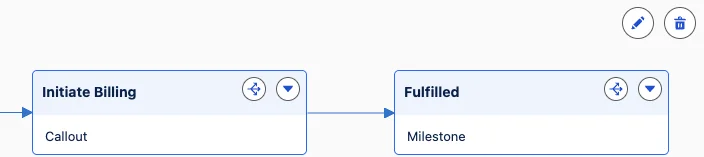
That is the most unpleasant property of this part of the chain: when a setting is missing, the invoice is not wrong — it does not exist. No error anywhere, just a month without invoices that nobody notices before close.
What finance has to say, and nobody asks them
- What an invoice must carry. Order reference, line number, cost centre, VAT wording: every missing line is a customer complaint.
- What happens when a customer removes something. Immediate credit, or deduction at the next instalment?
- Where each line lands in accounting. Assignment rules are set early, and some cannot be edited once created.
- Who approves before sending, and for how long. A “temporary” human approval becomes permanent monthly work.
Without those four answers, billing gets built twice: once on what the project team assumed, once on what finance wanted.
What goes wrong
- “We will do it by hand for now.” That temporary arrangement lasts, and it hides whatever was never settled.
- Invoices go out, but accounting checks behind them. Then the rule was not written, it was guessed.
- A month without invoices that nobody sees. The most expensive symptom, because it is found at close.
Technically, the four org prerequisites whose absence silently stops all billing are documented here: where billing actually starts.
What to take away
- Billing frequency, commitment term, payment term, revenue recognition: four distinct questions, four necessary answers.
- When a setting is missing the invoice is not wrong: it does not exist, and nothing says so.
- Four answers from finance save you from building billing twice.
A note on this article?
A correction, different behaviour on your org, a question left open: it is useful, and it gets fixed.