Decision notes
Knowing what the customer holds, as of today
A contract is not a PDF in a folder. It is the current state of what the customer owns — and it is the only thing an amendment or a renewal can build on.
How claims are labelled
One record per thing held
In the tool, what the customer owns is not a document: it is a list of records, one per product held, with its quantity, its dates and its amount.
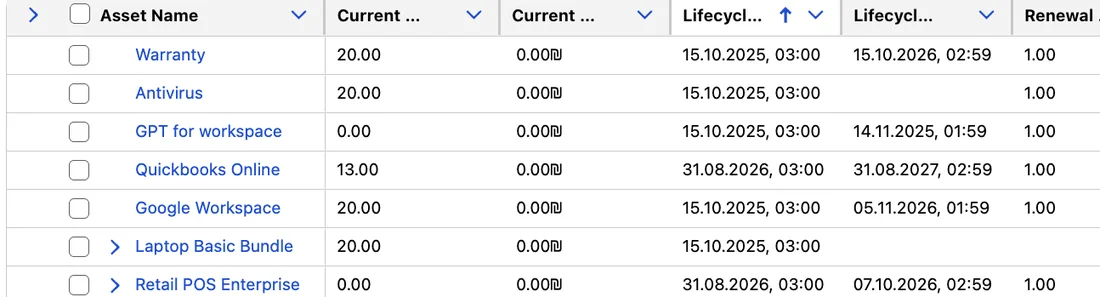
Each line also reads over time: how many they had last year, how many today, what it represents monthly.

An amendment adds, it does not replace
This is what surprises people most. When a customer removes licences mid-year, the original order is not edited: a new negative transaction is recorded, and the sum of the two says what they hold.

The practical consequence matters: invoices already sent are never rewritten. A removal produces a credit, or a smaller invoice next period, not a retroactive correction. That is what your accounting expects, and rarely what people imagine.
What the business has to decide
- What counts as “held”. A suspended product, a free licence, a module on trial: each needs an answer, or your installed-base figures mean nothing.
- Who may amend, and how far. Removing licences mid-commitment is not always the customer’s right. That is a commercial rule, not a setting.
- What happens mid-period. A removal in the middle of an already-billed quarter: immediate credit, or deduction next period? Finance decides.
What goes wrong
- The installed base does not reconcile with billing. If the two differ, one is wrong, and it is almost always the one nobody looks at.
- Amendments are done “at the next renewal”. The installed base is then wrong for months, and the renewal starts from a wrong base.
- Nobody can say what the customer held at a past date. Which is exactly the question an audit, a dispute or a migration asks.
What to take away
- What the customer holds is a list of current records, not a signed document.
- An amendment adds; it does not rewrite the original order — and issued invoices never move.
- Three business decisions: what counts as held, who may amend, and what to do with a removal inside an already-billed period.
A note on this article?
A correction, different behaviour on your org, a question left open: it is useful, and it gets fixed.